Showing posts with label Submachine gun. Show all posts

Wednesday, May 15, 2013

Thompson submachine gun


Thompson is a subbmachinegun use by the USE.It was invented by John T. Thompson.


History and service    

Development 

The Thompson Submachine Gun was developed by General John T. Thompson who originally envisioned an auto rifle (semi-automatic rifle) to replace the bolt action service rifles then in use. While searching for a way to allow such a weapon to operate safely without the complexity of a recoil or gas operated mechanism, Thompson came across a patent issued to John Bell Blish in 1915 based on adhesion of inclined metal surfaces under pressure.Thompson found a financial backer, Thomas F. Ryan, and started the Auto-Ordnance Company in 1916 for the purpose of developing his auto rifle. It was primarily developed in Newport, Kentucky. The principal designers were Theodore H. Eickhoff, Oscar V. Payne, and George E. Goll. By late 1917, the limits of the Blish Principle were discovered: rather than working as a locked breech, it functioned as a friction-delayed blowback action. It was found that the only cartridge currently in U.S. service suitable for use with the lock was the .45 ACP round. Thompson then envisioned a "one-man, hand-held machine gun" in .45 ACP as a "trench broom" for use in the on-going trench warfare of World War I. Payne designed the gun itself and its stick and drum magazines. The project was then titled "Annihilator I", and by 1918, most of the design issues had been resolved. However, the war ended before prototypes could be shipped to Europe.

At an Auto-Ordnance board meeting in 1919 to discuss the marketing of the "Annihilator", with the war over, the weapon was officially renamed the "Thompson Submachine Gun". While other weapons had been developed shortly prior with similar objectives in mind, the Thompson was the first weapon to be labeled and marketed as a "submachine gun". Thompson intended the weapon as an automatic 'trench-broom' to sweep enemy troops from the trenches, filling a role for which the Browning Automatic Rifle (BAR) had been proven ill-suited. This concept had already been developed by German troops using their own Bergmann MP18, the world's first submachine gun, in concert with sturmtruppen tactics.

Early use


The Thompson first entered production as the M1921. It was available to civilians, though its high price resulted in few sales. (A Thompson with one Type XX 20 shot "stick" magazine was priced at $200.00, at a time when a Ford automobile sold for $400.00.) M1921 Thompsons were sold in small quantities to the United States Postal Inspection Service (to protect the mail from a spate of robberies) and the United States Marine Corps. Federal sales were followed by sales to several police departments in the US and minor international sales to various armies and constabulary forces, chiefly in Central and South America.The Marines used their Thompsons in the Banana Wars and in China. It was popular with the Marines as a point-defense weapon for countering ambush by Nicaraguan guerrillas, and led to the organization of 4 man fire teams with as much firepower as a 9 man rifle squad. The major complaints against the Thompson were its weight, inaccuracy at ranges over 50 yards, and the lack of penetrating power of the .45 ACP pistol cartridge.
Archetypal gangster image of a Thompson in a violin case
The Thompson achieved most of its early notoriety in the hands of Prohibition and Depression-era gangsters, motorized bandits and the lawmen who pursued them, and in Hollywood films about their exploits, most notably in the St Valentine's Day Massacre. It has been referred to by one researcher as the "gun that made the twenties roar."
In 1926 the Cutts Compensator (a recoil brake) was offered as an option for the M1921; Thompsons with the compensator were cataloged as No. 21AC at the original price of $200.00, with the plain M1921 designated No. 21A at a reduced price of $175.00.
In 1928 Federal Laboratories took over distribution of the weapon from Thompson's Auto Ordnance Corporation. The cost at this time was US$225 per weapon, with $5 per 50-round drum and $3 for 20-round magazine.
Nationalist China acquired a quantity for use against Japanese land forces, and eventually began producing copies of the Thompson in small quantities for use by its armies and militias. In the 1930s, Taiyuan Arsenal produced copies of the Thompson for Yan Xishan, the warlord of Shanxi province.
The Federal Bureau of Investigation first acquired Thompsons in 1933 following the Kansas City Massacre.

Features 

Operating characteristics 
Early versions of the Thompson had a fairly high cyclic rate of fire, as high as 1,200rpm (rounds per minute), with most police Model 1921 at 850rpm and military Model 1928 at 720. Later M1 and M1A1 Thompsons averaged 600 rpm.[38] This rate of fire, combined with a rather heavy trigger pull and a stock with an excessive drop, increases the tendency for the barrel to climb off target in automatic fire.Compared to modern 9mm submachine guns, the .45 Thompson is quite heavy—weighing roughly the same as the contemporary M1 Garand battle rifle. This was one of the major complaints against the weapon made by servicemembers of militaries that issued the Thompson.
Although the drum magazine provided significant firepower, in military service it was found to be overly heavy and bulky, especially when slung on patrol or on the march.[39] It was also rather fragile, and cartridges tended to rattle inside it, producing unwanted noise. For these reasons, the 20-round and later 30-round box magazines soon proved most popular with military users of the M1928A1, and drum compatibility was not included in the design of the wartime M1 and M1A1 models. The Thompson was one of the earliest submachine guns to incorporate a double-column, double-feed box magazine design, which undoubtedly contributed to the gun's reputation for reliability. In addition, the gun performed better than most after exposure to rain, dirt, and mud.
The select fire (semi- or full automatic) Thompson fires from the "open bolt" position, in which the bolt is held fully to rearward by the sear when cocked. When the trigger is depressed, the bolt is released, traveling forward to chamber and simultaneously fire the first and subsequent rounds until either the trigger is released or the ammunition is exhausted. This eliminates the risk of "cook-off," which can sometimes occur in closed-bolt automatic weapons when the barrel becomes so hot that chambered rounds auto-ignite, causing the weapon to fire uncontrollably.


Monday, May 13, 2013

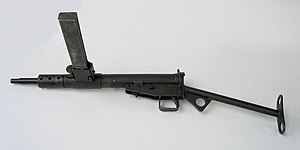
Sten


The Sten was a familiy of Britisch 9mm sub-machineguns used during the WW2 and the Korean war. They were notable for having a simple design and very low production cost making them effective insurgency weapons for resistance groups.STEN is an acronym, from the names of the weapon's chief designers, Major Reginald V. Shepherd and Harold Turpin, and EN for Enfield.Over 4 million Stens in various versions were made in the 1940s.


History

The credited designers were Major R. V. Shepherd, OBE, Inspector of Armaments in the Ministry of Supply Design Department at The Royal Arsenal, Woolwich, (later Assistant Chief Superintendent at the Armaments Design Department) and Mr. Harold John Turpin, Senior Draughtsman of the Design Department of the Royal Small Arms Factory (RSAF), Enfield. Shepherd had been recalled to service after having retired and spending some time at BSA.The Sten shared design features, such as its side-mounted magazine configuration, with the Royal Navy's Lanchester submachine gun, which was a copy of the German MP28. In terms of manufacture, the Lanchester was entirely different, being made of high-quality materials with pre-war fit and finish, in stark contrast to the Sten's austere execution. The Lanchester and Sten magazines were even interchangeable (though the Lanchester's magazine was longer with a 50 round capacity, compared to the Sten's 32 round capacity).The Sten used simple stamped metal components and minor welding, which required a minimum of machining and manufacturing. Much of the production could be performed by small workshops, with the firearms assembled at the Enfield site. Over the period of manufacture the Sten design was further simplified: the most basic model, the Mark III, could be produced from five man-hours work. Some of the cheapest versions were made from only 47 different parts. It was distinctive for its bare appearance (just a pipe with a metal loop for a stock), and its horizontal magazine. The Mark I was a more finely finished weapon with a wooden foregrip and handle; later versions were generally more spartan, although the final version, the Mark V, which was produced after the threat of invasion had died down, was produced to a higher standard.The Sten emerged while Britain was engaged in the Battle of Britain, facing invasion by Germany. The army was forced to replace weapons lost during the evacuation from Dunkirk while expanding at the same time. Prior to 1941 (and even later) the British were purchasing all the Thompson submachine guns they could from the United States, but these did not begin to meet demand. The American entry into the war at the end of 1941 placed an even bigger demand on the facilities making Thompsons. In order to rapidly equip a sufficient fighting force to counter the Axis threat, the Royal Small Arms Factory, Enfield, was commissioned to produce an alternative.The Sten underwent various design improvements over the course of the war. For example, the Mark 4 cocking handle and corresponding hole drilled in the receiver were created to lock the bolt in the closed position to reduce the likelihood of accidental discharges inherent in the design. Most changes to the production process were more subtle, designed to give greater ease of manufacture and increased reliability. Sten guns of late 1942 and beyond were, in general, highly effective weapons, though complaints of accidental discharge continued throughout the war. Such was the ease of manufacture that the Germans also produced a version of the Sten, the MP 3008, late in the war and the Sten was used extensively by Jewish partisans during the Israeli War of Independence.The Sten was replaced by the Sterling submachine gun from 1953 and was gradually withdrawn from British service in the 1960s. The other Commonwealth nations made or adopted their own replacements.


Design

Stoppages could occur due to a variety of problems: some as a result of poor maintenance, while others were peculiar to the Sten. Carbon buildup on the face of the breech or debris in the bolt raceway could cause a failure to fire, while a dirty chamber could cause a failure to feed. Firing the Sten by grasping the magazine with the supporting hand tended to wear the magazine catch, altering the angle of feed and causing a failure to feed.
The Sten was a blowback-operated submachine gun firing from an open bolt with a fixed firing pin on the face of the bolt. This means the bolt remains to the rear when the weapon is cocked, and on pulling the trigger the bolt flies forward under spring pressure, stripping the round from the magazine, chambering it and firing the weapon all in the same movement. There is no breech locking mechanism, the rearward movement of the bolt caused by the recoil impulse is arrested only by the mainspring and the bolt's inertia. The basic operating principles were similar to those of the German MP40, Russian PPSh-41, US M3 submachine gun and numerous other designs. These shared similar attributes and faults; they were simple and cheap to manufacture, and put an automatic weapon into the hands of soldiers, greatly increasing the short-range firepower of the infantry, especially when the main infantry weapon was a bolt-action rifle capable of only around 15 rounds per minute and not suited for short-range combat. However, the open-bolt firing and use of pistol ammunition severely restricted accuracy, with an effective range of around 100m.
Additional problems stemmed from the Sten's magazine, which was a direct copy of the one used in the German MP-38, originally in order to facilitate the use of German 9 mm magazines. Unfortunately, this decision necessarily incorporated the Erma magazine's faults in the process. The magazine had two columns of 9 mm cartridges in a staggered arrangement, merging at the top to form a single column. While other staggered magazines, such as the Thompson, fed from both the left and right side alternately (double-column, double feed), the Sten magazine, like the MP38, required the cartridges to gradually merge at the top of the magazine to form a single column (double column, single feed). As a consequence, any dirt or foreign matter in this taper area could cause feed malfunctions. Additionally, the walls of the magazine lip had to endure the full stresses of the rounds being pushed in by the spring. This, along with rough handling could result in deformation of the magazine lips (which required a precise 8° feed angle to operate), resulting in misfeeding and a failure to fire.
Modern 9 mm magazines, such as those used by the Sterling SMG, are curved and feed both sides to avoid this problem. If a Sten failed to feed due to jammed cartridges in the magazine, standard practice to clear it was as follows: remove magazine from Sten, tap the base of the magazine against the knee, re-insert magazine in Sten, then recocking the weapon and firing again as normal. To facilitate easier loading when attempting to push the cartridges down to insert the next one, a magazine filler tool was developed and formed part of the weapon's kit.
The slot on the side of the body where the cocking knob ran was also a target of criticism, as the long opening could allow foreign objects to enter. On the other hand, a beneficial side-effect of the Sten's minimalist design was that it would fire without any lubrication. This proved useful in desert environments such as the Western Desert Campaign, where oil attracted and retained dust and sand.
The open bolt design combined with cheap manufacture and rudimentary safety devices also meant the weapon was prone to accidental discharges, which proved hazardous. A simple safety could be engaged while the bolt was in the rearwards (cocked) position. However, if a Sten with a loaded magazine, with the bolt in the closed position, was dropped or the butt was knocked against the ground, the bolt could move far enough rearward to pick up a round (but not far enough to be engaged by the trigger mechanism) and the spring pressure could be enough to chamber and fire the round. The Mk 4 cocking handle was designed to prevent this by enabling the bolt to be locked in its forward position, thereby immobilising it. Wear and manufacturing tolerances could render these safety devices ineffective.


Wednesday, May 8, 2013

Heckler & Koch MP5


The Heckler & Koch MP5 (from German: Maschinenpistole 5, "machine pistol model 5") is a 9mm submachine gun of German design, developed in the 1960s by a team of engineers from the German small arms manufacturer Heckler & Koch GmbH (H&K) of Oberndorf am Neckar. There are over 100 variants of the MP5,including a semi-automatic version.
 The MP5 is one of the most widely used submachine guns in the world,having been adopted by 40 nations and numerous military, law enforcement, intelligence, and security organizations.
 In the 1990s, Heckler & Koch developed the Heckler & Koch UMP, the MP5's successor; both are available as of 2013.

History
 
Heckler & Koch, encouraged by the success of the G3 automatic rifle, developed a family of small arms consisting of four types of firearms all based on a common G3 design layout and operating principle. The first type was chambered for 7.62×51mm NATO, the second for the 7.62×39mm M43 round, the third for the intermediate 5.56×45mm NATO caliber, and the fourth type for the 9×19mm Parabellum pistol cartridge. The MP5 was created within the fourth group of firearms and was initially known as the HK54.
 Work on the MP5 began in 1964 and two years later it was adopted by the German Federal Police, border guard and army special forces.
 The MP5 is manufactured under license in several nations including Greece (formerly at EBO – Hellenic Arms Industry, currently at EAS – Hellenic Defense Systems), Iran (Defense Industries Organization), Mexico (SEDENA), Pakistan (Pakistan Ordnance Factories), Saudi Arabia, Sudan (Military Industry Corporation), Turkey (MKEK), and the United Kingdom (initially at Royal Ordnance, later diverted to Heckler & Koch Great Britain).
Features

The first MP5 models used a double-column straight box magazine, but since 1977, slightly curved, steel magazines are used with a 15-round capacity (weighing 0.12 kg) or a 30-round capacity (0.17 kg empty).
The adjustable iron sights (closed type) consist of a rotating rear diopter drum and a front post installed in a hooded ring. The rear sight is adjustable for both windage and elevation with the use of a special tool, being adjusted at the factory for firing at 25m with standard 124 grains FMJ 9x19mm NATO ammunition; the drum provides four different apertures of varying width used to adjust the light entrance in the diopter system, according to the user's eye relief and tactical situation, and not for firing at 25, 50, 75 and 100m as some people wrongly imagine.
The MP5 has a hammer firing mechanism. The trigger group is housed inside an interchangeable polymer trigger module (with an integrated pistol grip) and equipped with a three-position fire mode selector that serves as the manual safety toggle. The “S” or Sicher position in white denotes weapon safe, “E” or Einzelfeuer in red represents single fire, and “F” or Feuerstoß (also marked in red) designates continuous fire. The SEF symbols appear on both sides of the plastic trigger group. The selector lever is actuated with the thumb of the shooting hand and is located only on the left side of the original SEF trigger group or on both sides of the ambidextrous trigger groups. The safety/selector is rotated into the various firing settings or safety position by depressing the tail end of the lever. Tactile clicks (stops) are present at each position to provide a positive stop and prevent inadvertent rotation. The "safe" setting disables the trigger by blocking the hammer release with a solid section of the safety axle located inside the trigger housing.
The non-reciprocating cocking handle is located above the handguard and protrudes from the cocking handle tube at approximately a 45° angle. This rigid control is attached to a tubular piece within the cocking lever housing called the cocking lever support, which in turn, makes contact with the forward extension of the bolt group. It is not however connected to the bolt carrier and therefore cannot be used as a forward assist to fully seat the bolt group. The cocking handle is held in a forward position by a spring detent located in the front end of the cocking lever support which engages in the cocking lever housing. The lever is locked back by pulling it fully to the rear and rotating it slightly clockwise where it can be hooked into an indent in the cocking lever tube


Operating mechanism

The bolt rigidly engages the barrel extension—a cylindrical component welded to the receiver into which the barrel is pinned. The delay mechanism is of the same design as that used in the G3 rifle. The two-part bolt consists of a bolt head with rollers and a bolt carrier. The heavier bolt carrier lies up against the bolt head when the weapon is ready to fire and inclined planes on the front locking piece lie between the rollers and force them out into recesses in the barrel extension.
When fired, expanding propellant gases produced from the burning powder in the cartridge exert rearward pressure on the bolt head transferred through the base of the cartridge case as it is propelled out of the chamber. A portion of this force is transmitted through the rollers projecting from the bolt head, which are cammed inward against the inclined flanks of the locking recesses in the barrel extension and to the angled shoulders of the locking piece. The selected angles of the recesses and the incline on the locking piece produce a velocity ratio of about 4:1 between the bolt carrier and the bolt head. This results in a calculated delay, allowing the projectile to exit the barrel and gas pressure to drop to a safe level before the case is extracted from the chamber.
The delay results from the amount of time it takes for enough recoil energy to be transferred through to the bolt carrier in a sufficient quantity for it to be driven to the rear against the force of inertia of the bolt carrier and the forward pressure exerted against the bolt by the recoil spring. As the rollers are forced inward they displace the locking piece and propel the bolt carrier to the rear. The bolt carrier's rearward velocity is four times that of the bolt head since the cartridge remains in the chamber for a short period of time during the initial recoil impulse. After the bolt carrier has traveled rearward 4 mm, the locking piece is withdrawn fully from the bolt head and the rollers are compressed into the bolt head. Only once the locking rollers are fully cammed into the bolt head can the entire bolt group continue its rearward movement in the receiver, breaking the seal in the chamber and continuing the feeding cycle.
Since the 9×19mm Parabellum cartridge is relatively low powered, the bolt does not have an anti-bounce device like the G3, but instead the bolt carrier contains tungsten granules that prevent the bolt group from bouncing back after impacting the barrel extension. The weapon has a fluted chamber that enhances extraction reliability by bleeding gases backwards into the shallow flutes running along the length of the chamber to prevent the cartridge case from expanding and sticking to the chamber walls (since the bolt is opened under relatively high barrel pressure). A spring extractor is installed inside the bolt head and holds the case securely until it strikes the ejector arm and is thrown out of the ejection port to the right of the receiver. The lever-type ejector is located inside the trigger housing (activated by the movement of the recoiling bolt).
 

Tuesday, May 7, 2013

PPSh-41


History

World War II

The impetus for the development of the PPSh came partly from the Winter War against Finland, where the Finnish army employed the Suomi KP/-31 submachine gun as a highly effective tool for close-quarter fighting in forests or built-up urban areas. The Soviet weapon was developed in mid-1941 and was produced in a network of factories in Moscow, with high-level local Party members made directly responsible for production targets being met.
A few hundred weapons were produced in November 1941 and another 155,000 were produced over the next five months. By spring 1942, the PPSh factories were producing roughly 3,000 units a day.The PPSh-41 was a classic example of a design adapted for mass production (other examples of such wartime design were the M3 submachine gun, MP40 and the Sten). Its parts (excluding the barrel) could be produced by a relatively unskilled workforce with simple equipment available in an auto repair garage or tin shop, freeing up more skilled workers for other tasks. The PPSh-41 used 87 components compared to 95 for the PPD-40 and the PPSh could be manufactured with 7.3 machining hours compared with 13.7 hours for the PPD. Barrel production was often simplified by using barrels produced for the 7.62mm M1891 Mosin–Nagant rifle: the rifle barrel was cut in half, and two PPSh barrels were made from it after machining the chamber for the 7.62mm Soviet submachine gun cartridge.
After the German Army captured large numbers of the PPSh-41 during World War II, a program was instituted to convert the weapon to the standard German submachine gun cartridge - 9mm Parabellum. The Wehrmacht officially adopted the converted PPSh-41 as the MP41; unconverted PPSh-41s were designated MP717 and supplied with 7.63x25mm Mauser ammunition (which is dimensionally identical to 7.62x25mm, but somewhat less powerful). German-language manuals for the use of captured PPShs were printed and distributed in the Wehrmacht.
The PPS, an even simpler submachine gun, was introduced in Soviet service, although it did not replace the PPSh-41 during the war.
The Soviet Union also experimented with the PPSh-41 in a close air support anti-personnel role, mounting dozens of the submachine guns in forward fuselage racks on the Tu-2sh variant of the Tupolev Tu-2 bomber.
Over 6 million PPSh submachine guns were produced by the end of the war. The Soviets would often equip whole regiments and even entire divisions with the weapon, giving them unmatched short-range firepower. Thousands more were dropped behind enemy lines to equip large partisan formations to disrupt German supply lines and communications.


Features

The PPSh-41 on display.
The PPSh-41 fired the standard Soviet pistol and submachine gun cartridge, the 7.62x25mm (Tokarev). Weighing approximately 12 pounds (5.45 kg) with a loaded 71-round drum and 9.5 pounds (4.32 kg) with a loaded 35-round box magazine, the PPSh was capable of about 1000 rounds per minute, a very high rate of fire in comparison to most other military submachine guns of World War II. It was a durable, low-maintenance weapon made of low-cost, easily-obtained components, primarily stamped sheet metal and wood. The final production PPSh had top ejection and an 'L' type rear sight that could be adjusted for ranges of 100 and 200 meters. A crude compensator was built into the barrel jacket, intended to reduce muzzle climb during automatic fire. The compensator was moderately successful in this respect, but it greatly increased the muzzle flash and report of the weapon. The PPSh also had a hinged receiver to facilitate field-stripping and cleaning the weapon. A chrome-lined bore enabled the PPSh to withstand both corrosive ammunition and long intervals between cleaning. No forward grip or forearm was provided, and the operator generally had to grasp the weapon behind the drum magazine with the supporting hand, or else hold the lower edge of the drum magazine. Though 35-round curved box magazines were available from 1942, the average Soviet infantryman in World War II carried the PPSh with the original 71-round drum magazine.
A copy of the Finnish M31 Suomi magazine, the PPSh drum magazine held 71 rounds. In practice, misfeeding was likely to occur with more than about 65.In addition to feed issues, the drum magazine was slower and more complicated to load with ammunition than the later 35-round box magazine that increasingly supplemented the drum after 1942. While holding fewer rounds, the box magazine did have the advantage of providing a superior handhold for the supporting hand. Although the PPSh was equipped with a sliding bolt safety, the weapon's open-bolt design still presented a risk of accidental discharge if the gun was dropped on a hard surface.