Showing posts with label Sniper rifles. Show all posts

Thursday, May 16, 2013

Gewehr 43


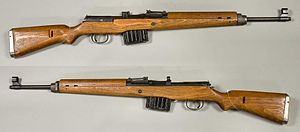
Gewehr 43 is a rifle used by Germany during WWII.It was a modification of G41.


HISTORY

Germany's quest for a semi-automatic infantry rifle resulted in two designs - the G41(M) and G41(W), from Mauser and Walther arms respectively. The Mauser design proved unreliable in combat when introduced in 1941 and at least 12,755 were made. The Walther design fared better in combat but still suffered from reliability problems. In 1943 Walther combined a new modified gas system with aspects of the G41(W) providing greatly improved performance. It was accepted and entered into service as the Gewehr 43, renamed Karabiner 43 in 1944, with production amounting to just over 400,000 between 1943-1945.

OTHER 


There were many small variations introduced on the G/K43 throughout its production cycle. The important consideration is that no changes were made to the rifle design specifically to coincide with the nomenclature change from Gewehr to Karabiner, with the exception of the letter stamped on the side. Careful study of actual pieces will show that many G-marked rifles had features found on K-marked rifles and vice versa. There is therefore no difference in weight or length between the G43 and the K43. Variations in barrel length did exist, but those were the product of machining tolerances, differences between factories, and/or experimental long-barreled rifles. An unknown number of late-war K43 rifles were chambered for the 7.92×33mm Kurzcartridge and modified to accept StG44 magazines.

K43 with mounting rail
Though most G/K43s are equipped with a telescopic sight mounting rail, the vast majority of the rifles were issued in their standard infantry form without a scope. When equipped with a scope, it was exclusively the ZF 4 4-power telescopic sight. No other known scope/mount combinations were installed by the German military on G/K43's during World War II. Many strange variations have shown up after the war, but all have been proven to be the work of amateur gunsmiths. Rifles with a broken-off butt are common, as German soldiers were instructed to render semi-automatic rifles useless when in danger of capture.

Monday, May 6, 2013

Dragunov sniper rifle

TypeSniper rifle, designated marksman rifle
Place of origin Soviet Union
Service history
In service1963–present

WarsVietnam War, Cambodian–Vietnamese War, Soviet war in Afghanistan, Gulf War, Somali Civil War, Operation Restore Hope,Operation Gothic Serpent, War in Afghanistan (2001-present), Iraq WarYugoslav Wars, First andSecond Chechen Wars,Cambodian–Thai border dispute,2008 South Ossetia War, Kargil War, Libyan civil war, Syrian civil war
Production history
DesignerYevgeny Dragunov
Designed1958–1963
ManufacturerIzhmash, Ordnance Factories Organisation, Norinco
Produced1963–present

Specifications
Weight4.30 kg (9.48 lb) (with scope and unloaded magazine)
4.68 kg (10.3 lb) (SVDS)
4.40 kg (9.7 lb) (SVU)
5.02 kg (11.1 lb) (SWD-M)
Length1,225 mm (48.2 in) (SVD)
1,135 mm (44.7 in) stock extended / 815 mm (32.1 in) stock folded (SVDS)
900 mm (35.4 in) (SVU)
1,125 mm (44.3 in) (SWD-M)
Barrel length620 mm (24.4 in) (SVD, SWD-M)
565 mm (22.2 in) (SVDS)
600 mm (23.6 in) (SVU)

Cartridge7.62×54mmR
ActionGas-operated, rotating bolt
Muzzle velocity830 m/s (2,723 ft/s) (SVD)
810 m/s (2,657.5 ft/s) (SVDS)
800 m/s (2,624.7 ft/s) (SVU)
Effective range800 m
Maximum range1,300 m with scope
1,200 m with iron sights
Feed system10-round detachable boxmagazine
SightsPSO-1 telescopic sight and iron sights with an adjustable rear notch sight
 

The Dragunov sniper rifle (formally Russian: Снайперская винтовка Драгунова, Snayperskaya Vintovka Dragunova (SVD), literally "Dragunov's sniper rifle") is a semi-automatic sniper rifle/designated marksman rifle chambered in 7.62×54mmR and developed in the Soviet Union.
The Dragunov was designed as a squad support weapon since, according to Soviet and Soviet-derived military doctrines, the long-range engagement ability was lost to ordinary troops when submachine guns and assault rifles (which are optimized for close-range and medium-range, rapid-fire combat) were adopted. For that reason, it was originally named "Полуавтоматическая винтовка Драгунова" Dragunov's Semi-automatic Rifle.
It was selected as the winner of a contest that included three competing designs: by Sergei Simonov, Aleksandr Konstantinov and Yevgeny Dragunov. Extensive field testing of the rifles conducted in a wide range of environmental conditions resulted in Dragunov’s proposal being accepted into service in 1963. An initial pre-production batch consisting of 200 rifles was assembled for evaluation purposes, and from 1964 serial production was carried out by Izhmash.
Since then, the Dragunov has become the standard squad support weapon of several countries, including those of the former Warsaw Pact. Licensed production of the rifle was established in China (Type 79 and Type 85) and Iran (as a direct copy of the Chinese Type 79).

Operating mechanism

The Dragunov is a semi-automatic gas-operated rifle with a short-stroke gas-piston system. The barrel breech is locked through a rotating bolt (left rotation) and uses three locking lugs to engage corresponding locking recesses in the barrel extension. The rifle has a manual, two-position gas regulator.
After discharging the last cartridge from the magazine, the bolt carrier and bolt are held back on a bolt catch that is released by pulling the cocking handle to the rear. The rifle has a hammer-type striking mechanism and a manual lever safety selector. The firing pin is a "free-floating" type and, as a result, some soft-primered ammunition had the reputation of causing a "slam fire" event. Thus, military grade ammunition with primers confirmed to be properly seated is recommended for the Dragunov and its variants. This appears to have solved the "slam fire" issue. The rifle's receiver is machined to provide additional accuracy and torsional strength. The Dragunov's receiver bears a number of similarities to the AK action, such as the large dust cover, iron sights and lever safety selector, but these similarities are primarily cosmetic in nature.

Barrel

The barrel profile is relatively thin to save weight and is ended with a slotted flash suppressor. The barrel’s bore is chrome-lined for increased corrosion resistance, and features 4 right-hand grooves. It is not rifled over its full length but partly over a length of 547 mm (21.5 in). In the 1960s, the twist rate was 320 mm (1:12.6 in). During the 1970s, the twist rate was tightened to 240 mm (1:9.4 in), which reduced the accuracy of fire with sniper cartridges by 19%. This adaptation was done in order to facilitate the use of tracer and armor-piercing incendiary ammunition, since these bullet types required a shorter twist rate for adequate stabilization.

Ammunition feeding

The weapon is fed from a curved box magazine with a 10-round capacity and the cartridges are double-stacked in a checker pattern.
SIGHTS
The rifle features mechanically adjustable backup iron sights with a sliding tangent rear sight (the sight can be adjusted to a maximum range of 1,200 m). The iron sights can be used with or without the standard issue optical sight in place. This is possible because the scope mount does not block the area between the front and rear sights.
The Dragunov is issued with a quick-detachable PSO-1 optical sight. The PSO-1 sight (at a total length of 375 mm with a lens cover and sun shade, 4x magnification and 6° field of view) mounts to a proprietary side rail mount that does not block the view of the iron sight line. The PSO-1 sight includes a variety of features, such as a bullet drop compensation (BDC) elevation adjustment knob, an illuminated rangefinder grid, a reticle that enables target acquisition in low light conditions as well as an infrared charging screen that is used as a passive detection system. The current version of the sight is the PSO-1M2. This telescopic sight is different from the original PSO-1 only in that it lacks the now obsolete Infra-Red detector. The PSO-1 sight enables targets to be engaged at ranges upwards of 1,300 m; effective ranges in combat situations have been stated at between 600 to 1,300 m, depending on the nature of the target (point or area target) quality of ammunition and skill of the shooter.
Several other models of the PSO sight are available with varying levels of magnification and alternative aiming reticules. Rifles designated SVDN come equipped with a night sight, such as the NSP-3, NSPU, PGN-1, NSPUM or the Polish passive PCS-6.


Zastava M48

TypeBolt-action rifle
Place of origin Yugoslavia
Service history
In service1948–present
Used byYugoslavia, Egypt, Algeria, Iraq
WarsYugoslav Wars
Production history
Designed1948
Produced1950–1965
Number built1,224,000+
VariantsM48, M48A, M48B, M48BO
Specifications
Weight3.9 kg (8.6 lb)
Length1105 mm (43.5 in)
Barrel length597 mm (23.25 in)

Cartridge7.92×57 mm IS (8 mm Mauser)
ActionBolt action
Muzzle velocity760 m/s (2,493 ft/s)
Effective range500 m (547 yd) (with iron sights)
800+ m (875 yd) (with optics)
Feed system5-round stripper clip, internal box magazine
Sightsrear: standard V-notch, adjustable to 2,000 meters in 100 m increments
front: hooded, inverted V

The Zastava M48 is a post World War II Yugoslavian version of the Belgian Fabrique Nationale designed Mauser Model 1924 short rifle which was produced under contract by the "Kingdom of Yugoslavia" beginning in 1928 and ending with the Nazi occupation in 1941. After World War II, the Yugoslavs took this design and incorporated modifications based upon Germany's Mauser Karabiner 98k. Although similar in general appearance to that of the German rifle, many of the parts of these two rifles are not interchangeable, especially the bolt and related action parts. The main difference between the M48 and the K98k is that the M48 uses an intermediate-length receiver. They are usually easily identified by the top handguard, which extends behind the rear sight and ends just in front of the receiver ring, although this feature exists on other models as well. M48's are regarded as a military surplus firearm and can be collected in the USA, Canada and Australia at a generally cheap price due to the numbers recently imported from Europe.

Combat use

Most M48's were put into government storage shortly after they were manufactured. Most M48's that are encountered in the United States and Australia today show only slight wear—usually from storage. Many rifles are sold with accessories, including bayonet, bayonet scabbard, leather bayonet frog, ammo pouches, cleaning rod, and field cleaning kit. The rifles are normally sold coated in the protective grease 'cosmoline' which needs to be cleaned out before the rifle is fired. The condition is frequently excellent due to a Yugoslavian maintenance program that cleaned and inspected the stored rifles in rotation every 5 years until that nation's breaking up.
As such, the M48 only saw limited use in the Yugoslav Wars. Often the M48 was used as the basis for a sniper rifle, drilled and tapped for the ZRAK 4x32 telescopic sight and mounts.However, other than an experimental batch of approximately 4000 rifles, no official M48 sniper rifle was ever fielded by the Yugoslav Army. (ref. Serbian & Yugoslav Mauser Rifles by Branko Bogdanovic, North Cape Publishing, 2005)

Sunday, May 5, 2013

Lee-Enfield


TypeBolt-action rifle
Place of originUnited Kingdom United Kingdom
Service history
In serviceMLE: 1895–1926
SMLE: 1907–present

WarsSecond Boer War
World War I
Various Colonial conflicts
Irish War of Independence
Irish Civil War
World War II
Indonesian National Revolution
Indo-Pakistani Wars
Greek Civil War
Malayan Emergency
French Indochina War
Korean War
Arab-Israeli War
Suez Crisis
Mau Mau Uprising
Bangladesh Liberation War
Nepalese Civil War
Afghanistan conflict
Production history
DesignerJames Paris Lee, RSAF Enfield
ProducedMLE: 1895–1907
SMLE: 1907–present
Number built17,000,000+

Specifications
Weight4 kg (8.8 lb)
LengthSMLE: 44 in (1,118 mm)
Barrel lengthMLE: 30.2 in (767 mm)
SMLE: 25.2 in (640 mm)

Cartridge.303 Mk VII SAA Ball
ActionBolt-action
Muzzle velocity744 m/s (2,441 ft/s)
Effective range550 yd (503 m)
Maximumrange3,000 yd (2,743 m)
Feed system10-round magazine, loaded with 5-round charger clips
SightsSliding ramp rear sights, fixed-post front sights, "dial" long-range volley sights; telescopic sights on sniper models.


The Lee-Enfield bolt-action, magazine-fed, repeating rifle was the main firearm used by the military forces of the British Empire and Commonwealth during the first half of the 20th century. It was the British Army's standard rifle from its official adoption in 1895 until 1957.
A redesign of the Lee-Metford which had been adopted by the British Army in 1888, the Lee-Enfield superseded the earlier Martini-Henry, Martini-Enfield, and Lee-Metford rifles. It featured a ten-round box magazine which was loaded with the .303 British cartridge manually from the top, either one round at a time or by means of five-round chargers. The Lee-Enfield was the standard issue weapon to rifle companies of the British Army and other Commonwealth nations in both the First and Second World Wars (these Commonwealth nations included Canada, Australia and South Africa, among others). Although officially replaced in the UK with the L1A1 SLR in 1957, it remained in widespread British service until the early/mid-1960s and the 7.62 mm L42 sniper variant remained in service until the 1990s. As a standard-issue infantry rifle, it is still found in service in the armed forces of some Commonwealth nations, notably with the Indian Police and Bangladesh Police, which makes it the longest-serving military bolt-action rifle still in official service.The Canadian Forces' Rangers Arctic reserve unit still use Enfield 4 rifles as of 2012, with plans announced to replace the weapons sometime in 2014 or 2015.Total production of all Lee-Enfields is estimated at over 17 million rifles.
The Lee-Enfield takes its name from the designer of the rifle's bolt system—James Paris Lee—and the factory in which it was designed—the Royal Small Arms Factory in Enfield. In Australia, New Zealand, Southern Africa and Canada the rifle became known simply as the "303".


History and Design


The Lee-Enfield rifle was derived from the earlier Lee-Metford, a mechanically similar black-powder rifle, which combined James Paris Lee's rear-locking bolt system with a barrel featuring rifling designed by William Ellis Metford. The Lee action cocked the striker on the closing stroke of the bolt, making the initial opening much faster and easier compared to the "cock on opening" (i.e., the firing pin cocks upon opening the bolt) of the Mauser Gewehr 98 design. The rear-mounted lugs place the bolt operating handle much closer to the operator, over the trigger, making it quicker to operate than traditional designs like the Mauser.The rifle was also equipped with a detachable sheet-steel, 10-round, double-column magazine, a very modern development in its day. Originally, the concept of a detachable magazine was opposed in some British Army circles, as some feared that the private soldier might be likely to lose the magazine during field campaigns. Early models of the Lee-Metford and Lee-Enfield even used a short length of chain to secure the magazine to the rifle.
The fast-operating Lee bolt-action and large magazine capacity enabled a well-trained rifleman to perform the "mad minute" firing 20 to 30 aimed rounds in 60 seconds, making the Lee-Enfield the fastest military bolt-action rifle of the day. The current world record for aimed bolt-action fire was set in 1914 by a musketry instructor in the British Army—Sergeant Instructor Snoxall—who placed 38 rounds into a 12-inch-wide (300 mm) target at 300 yards (270 m) in one minute.[10] Some straight-pull bolt-action rifles were thought faster, but lacked the simplicity, reliability, and generous magazine capacity of the Lee-Enfield. Several First World War accounts tell of British troops repelling German attackers who subsequently reported that they had encountered machine guns, when in fact it was simply a group of well-trained riflemen armed with SMLE Mk III rifles.

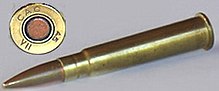
Standard Mk VII .303 inch cartridge for Lee-Enfield rifle
The Lee-Enfield was adapted to fire the .303 British service cartridge, a rimmed, high-powered rifle round. Experiments with smokeless powder in the existing Lee-Metford cartridge seemed at first to be a simple upgrade, but the greater heat and pressure generated by the new smokeless powder wore away the shallow, rounded, Metford rifling after approximately 6000 rounds.Replacing this with a new square-shaped rifling system designed at the Royal Small Arms Factory (RSAF) Enfield solved the problem, and the Lee-Enfield was born.


Sniper rifles


During both World Wars and the Korean War, a number of Lee-Enfield rifles were modified for use as sniper rifles. The Australian Army modified 1,612[44] Lithgow SMLE No. 1 Mk. III* rifles by adding a heavy target barrel, cheek-piece, and a World War I era Pattern 1918 telescope, creating the SMLE No. 1 Mk. III* (HT). (HT standing for "Heavy Barrel, Telescopic Sight),[7] which saw service in the Second World War, Korea, and Malaya and was used for Sniper Training through to the late 1970s.[45] There is evidence that some SMLE No. 1 Mk. III* (HT) sniper rifles were used by Australian forces during the later stages of the Vietnam War.[citation needed]
During the Second World War, standard No. 4 rifles, selected for their accuracy during factory tests, were modified by the addition of a wooden cheek-piece, and telescopic sight mounts designed to accept a No. 32 3.5x telescopic sight.his particular sight progressed through three marks with the Mk. 1 introduced in 1942, the Mk. 2 in 1943 and finally the Mk. 3 in 1944. Many Mk. 3s and Mk. 2/1s (Mk. 2s Modified to Mk. 3 standard) were later modified for use with the 7.62 mm NATO L42A1 Sniper Rifle. They were known by the designation Telescope Straight, Sighting L1A1.
Holland and Holland, the famous British sporting gun manufacturers, converted the majority of No. 4 Mk. I (T) sniper rifles, with the rest converted by BSA and, in Canada, Long Branch arsenal.These rifles were extensively employed in various conflicts until the late 1960s, and when the British military switched over to the 7.62x51 NATO round in the 1950s, many of the No. 4 Mk I (T) sniper rifles were converted to the new calibre and designated L42A1.[35] The L42A1 sniper rifle continued as the British Army's standard sniper weapon until the mid-1980s, being replaced by Accuracy International's L96.


Saturday, May 4, 2013

Mosin–Nagant


TypeBolt action rifle
Place of origin Russian Empire
 Soviet Union
Service history
In service1891–present
Used bySee Users
WarsBoxer Rebellion
Russo-Japanese War
World War I
Finnish Civil War
Russian Revolution
Russian Civil War
Polish–Soviet War
Turkish War of Independence
Chinese Civil War
Spanish Civil War
Second Sino-Japanese War
Soviet–Japanese border conflicts
Winter War
Continuation War
World War II
Great Patriotic War
First Indochina War
Korean War
Yemeni Civil War
Laotian Civil War
Vietnam War
Cambodian Civil War
Cambodian–Vietnamese War
Thai–Laotian Border War
Afghan Civil War
Soviet war in Afghanistan
Yugoslav Wars
Chechen Wars
War in Afghanistan
Iraq War
others
Production history
DesignerCaptain Sergei Mosin, Léon Nagant.[1]
Designed1891
ManufacturerTula, Izhevsk, Sestroryetsk,Manufacture Nationale d'Armes de Châtellerault, Remington, New England Westinghouse, many others
Produced1891–present
Number built~37,000,000 (Russia/Soviet Union)

Specifications
Weight4 kg (8.8 lb) (M91/30)
3.4 kg (7.5 lb) (M38)
4.1 kg (9.0 lb) (M44)
Length1,232 mm (48.5 in) (M91/30)
1,013 mm (39.9 in) (carbines)
Barrel length730 mm (29 in) (M91/30)
514 mm (20.2 in) (carbines)

Cartridge7.62×54mmR
7.62×53mmR (Finnish variants only)
7.92×57mm Mauser (Polish variants)
ActionBolt-action
Muzzle velocityLight ball, ~ 865 m/s (2,838 ft/s) rifle
~ 800 m/s (2,625 ft/s) carbine.
Effective range500 m (550 yards), 800+ m (with optics)
Feed system5-round non-detachable magazine, loaded individually or with five-round stripper clips.
SightsRear: ladder, graduated from 100 m to 2,000 m (M91/30) and from 100 m to 2,000 m (M38 and M44); Front: hooded fixed post (drift adjustable)PU 3.5 and PEM scope also mounted


Initial design and tests


During the Russo-Ottoman War of 1877–1878, Russian troops armed mostly with Berdan single-shot rifles suffered heavy casualties against Turkish troops with Winchester repeating rifles. This showed Russian commanders the need to modernize the Imperial Army. In 1882 the Russian Main Artillery Administration undertook the task of producing a magazine-fed, repeater rifle. After failing to adequately modify the Berdan rifle to meet the specified requirements, a "Special Commission for the testing of Magazine Fed Rifles" was formed to test new designs.
In 1889, three rifles were submitted for evaluation: Captain Sergei Ivanovich Mosin of the Imperial Army submitted his "3-line" caliber (.30 cal, 7.62 mm) rifle; Belgian designer Léon Nagantsubmitted a "3.5-line" design; and a Captain Zinoviev submitted another "3-line" design. (One "line" = 1/10".)
When trials concluded in 1891, the evaluators were split in their decision. The main disadvantages of Nagant's rifle were a more complicated mechanism and a long and tiresome procedure of disassembling (which required special instruments – it was necessary to unscrew two screws). Mosin's rifle was mainly criticized for its lower quality of manufacture and materials, resulting in a slightly larger number of stoppages. The Commission voted 14 to 10 to approve Nagant's rifle. However, the head of the Commission, General Chagin, ordered subsequent tests held under the Commission's supervision during which Mosin's rifle showed its advantages, leading to its selection over the Nagant.

Technical detail

The Mosin has a commonality with Mauser rifles, in that it uses two front locking lugs to lock up the action. However, the lugs lock in the horizontal position, whereas the Mauser locks vertically. The Mosin bolt assembly is multi-piece instead of unitary, like the Mauser, and uses interchangeable bolt-heads like the Lee-Enfield. Unlike the Mauser, which uses a so-called "controlled feed" bolt head, the Nagant has a recessed head for the cartridge base, what modern terminology calls a "push feed". While modern push-feeds use a plunger ejector in the bolt face, the Mosin uses a blade ejector in the receiver, similar to the Mausers. Also, the extractor is spring-loaded—unlike the fixed Mauser. The bolt is removed by simply pulling it fully to the rear of the receiver and squeezing the trigger from there.
Like the Mauser, the bolt lift arc on the Mosin–Nagant is 91 degrees, versus 60 degrees on the Lee-Enfield. The location of its bolt handle is an unusual feature of the Mosin–Nagant, protruding out of the ejection/loading port rather than connecting to the bolt in the rear. Furthermore, the handle is attached to a protrusion on the bolt, which houses the firing pin and serves a similar function to Mauser's "third" or "safety" lug.

Increased world-wide use


In the years after World War II, the Soviet Union ceased production of all Mosin–Nagants and withdrew them from service in favor of the SKS series carbines and eventually the AK series rifles. Despite its growing obsolescence, the Mosin–Nagant saw continued service throughout the Eastern bloc and the rest of the world for many decades to come. Mosin–Nagant rifles and carbines saw service on many fronts of the Cold War, from Korea and Vietnam to Afghanistan and along the Iron Curtainin Europe. They were kept not only as reserve stockpiles, but front-line infantry weapons as well.
Virtually every country that received military aid from the Soviet Union, China, and Eastern Europe during the Cold War used Mosin–Nagants at various times. Middle Eastern countries within the sphere of Soviet influence — Egypt, Syria, Iraq,Afghanistan and Palestinian fighters — have received them in addition to other more modern arms. Mosin–Nagants have also seen action in the hands of both Soviet and Mujahadeen forces in Afghanistan during the Soviet Union's occupation of the country during the 1970s and the 1980s. Their use in Afghanistan continued on well into the 1990s and the early 21st century by Northern Alliance forces. Even after the collapse of the Soviet Union, Mosin–Nagants are still commonly found on modern battlefields around the world. They were used by insurgent forces in the Iraq War and the current war in Afghanistan. Separatists have also used the rifles alongside more modern Russian firearms in the Second war in Chechnya and even today, it seems that some 91/30 PU sniper rifles remain in service and are used on the field by Russian police, Spetsnaz, paramilitary factions in Chechnya and other Caucasus republics like Dagestan and Ingushetia. In addition, scoped Mosins continue to serve as issue sniper rifles with the Afghan Army, the Iraqi Army, the Finnish Army, and with a micrometer sight as a sniper training and precision target rifle with the Finns.
[edit]