Showing posts with label Assault rifle. Show all posts

Saturday, May 18, 2013

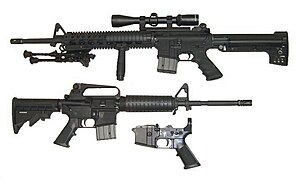
AR-15


The AR-15 is a lightweight, 5.56 mm, magazine-fed, semi-automatic rifle, with a rotating-lock bolt, actuated by direct impingement gas operation or long/short stroke piston operation. It is manufactured with the extensive use of aluminum alloys and synthetic materials.
The AR-15 was first built by ArmaLite as an assault rifle for the United States armed forces. Because of financial problems, ArmaLite sold the AR-15 design to Colt. The select-fire version of the AR-15 entered the U.S. military system as the M16 rifle. Colt then started selling the semi-automatic version of the M16 rifle as the Colt AR-15 for civilian sales in 1963.Although the name "AR-15" remains a Colt registered trademark, variants of the firearm are independently made, modified and sold under various names by multiple manufacturers.


History 

1973 Colt AR-15 SP1 rifle with 'slab side' lower receiver (lacking raised boss around magazine release button) and original Colt 20 round box magazine
The AR-15 is based on the 7.62 mm AR-10, designed by Eugene Stoner, Robert Fremont, and L. James Sullivan of the Fairchild ArmaLite corporation.The AR-15 was developed as a lighter,5.56 mm version of the AR-10. The "AR" in AR-15 comes from the ArmaLite name and stands for "ArmaLite Rifle". ArmaLite's AR-1, AR-5, and some subsequent models were bolt action rifles, the AR-7 a semi-automatic rifle and there are shotguns and pistols whose model numbers include the "AR" prefix.

ArmaLite sold its rights to the AR-10 and AR-15 to Colt in 1959. After a tour by Colt of the Far East, the first sale of AR-15s was made to Malaysia on September 30, 1959, with Colt's manufacture of their first 300 AR-15s in December 1959. Colt marketed the AR-15 rifle to various military services around the world, including the U.S. Navy, Air Force, Army, and Marine Corps. The AR-15 was eventually adopted by the United States military under the designation M16. Colt continued to use the AR-15 trademark for its semi-automatic variants (AR-15, AR-15A2) which were marketed to civilian and law-enforcement customers. The original AR-15 was a very lightweight weapon, weighing less than 6 pounds with empty magazine. Later heavy-barrel versions of the civilian AR-15 can weigh upwards of 8.5 lb.
Today the AR-15 and its variations are manufactured by many companies and are popular among civilian shooters and law enforcement forces around the world due to their accuracy and modularity (for more history on the development and evolution of the AR-15 and derivatives see M16 rifle).
The trademark "AR15" or "AR-15" is registered to Colt Industries, which maintains that the term should only be used to refer to their products. Other AR-15 manufacturers make AR-15 clones marketed under separate designations, although colloquially these are sometimes referred to by the term AR-15.
Some notable features of the AR-15 include:
  • Aircraft grade forged 7075-T6 aluminum receiver is lightweight, highly corrosion-resistant, and machinable.
  • Modular design allows the use of numerous accessories such as after market sights, vertical forward grips, lighting systems, night vision devices, laser-targeting devices, muzzle brakes/flash hiders, sound suppressors, bipods, etc., and makes repair easier
  • Straight-line stock design eliminates the fulcrum created by traditional bent stocks, reducing muzzle climb.
  • Small caliber, accurate, lightweight, high-velocity round (.223/5.56x45mm)
  • Easily adapted to fire numerous other rounds
  • Front sight adjustable for elevation
  • Rear sight adjustable for windage (most models) and elevation (some models)
  • Wide array of optical aiming devices available in addition to or as replacements of iron sights
  • Direct impingement gas system (as designed) with short or long stroke gas piston, or direct blowback operating systems available
  • Synthetic pistol grip and butt stock that do not swell or splinter in adverse conditions (regulated in some states)
  • Various magazine capacity, ranging from 10 to 30-round or more
  • Ergonomic design that makes the charging handle, selector switch (safety), magazine release, and bolt catch assembly easy to access.
  • 4 MOA Accuracy as a MILSPEC standard
AR-15 sight picture
Semi-automatic AR-15s for sale to civilians are internally different from the full automatic M16, although nearly identical in external appearance. The hammer and trigger mechanisms are of a different design. The bolt carrier and internal lower receiver of semi-automatic versions are milled differently, so that the firing mechanisms are not interchangeable. This was done to satisfy United States Bureau of Alcohol, Tobacco, Firearms and Explosives (ATF) requirements that civilian weapons may not be easily convertible to full-automatic. In the late 1970s and early '80s, items such as the "Drop In Auto Sear" or "lightning-link," conversion to full automatic was very straightforward (sometimes requiring machining of the lower receiver with use of a lathe and M16 Bolt Carrier Group).Such modifications, unless using registered and transferable parts made prior to May 19, 1986, are illegal. (The Firearm Owners Protection Act in 1986 has redefined a machine gun to include individual components where a semi-automatic firearm can be converted to full-automatic based on a 1981 ATF ruling on machine gun parts.) Since 1993, The Bolt Carrier Groups used in AR-15 type rifles for civilians have employed additional measures to prevent modification to full auto. Colt AR-15's use a metal alloy wall separating the Fire Control group from the Sear, preventing use of such items.
Automatic variants have a three-position rotating selective fire switch, allowing the operator to select between three modes: safe, semi-automatic, and either automatic or three-round burst, depending on model. Civilian Colt AR-15 models do not have three-round burst or automatic settings on the fire selector, though some other makers may mark that way for collectors and re-enactors, even though the guns will not fire in that mode. In semi-automatic only variants, the selector only rotates between safe and semi-automatic. Due to this, weapons modified to full automatic using a lightning-link are capable of full automatic fire only—unless a special full automatic fire select mechanism and modified selector-switch is substituted.


The main mechanism of operation for the rifle is known as direct gas impingement. Gas is tapped from the barrel as the bullet moves past a gas port located above the rifle's front sight base. The gas rushes into the port and down a gas tube, located above the barrel, which runs from the front sight base into the AR-15's upper receiver. Here, the gas tube protrudes into a "gas key" (bolt carrier key) which accepts the gas and funnels it into the bolt carrier.

Operating mechanism 

Diagram of an M16 rifle, firing
The main mechanism of operation for the rifle is known as direct gas impingement. Gas is tapped from the barrel as the bullet moves past a gas port located above the rifle's front sight base. The gas rushes into the port and down a gas tube, located above the barrel, which runs from the front sight base into the AR-15's upper receiver. Here, the gas tube protrudes into a "gas key" (bolt carrier key) which accepts the gas and funnels it into the bolt carrier.
The bolt and bolt carrier together form a piston, which is caused to expand as the cavity in the bolt carrier fills with high pressure gas. The bolt is locked into the barrel extension, so this expansion forces the bolt carrier backward a short distance in line with the stock of the rifle to first unlock the bolt. As the bolt carrier moves toward the butt of the gun, the bolt cam pin, riding in a slot on the bolt carrier, forces the bolt to turn and unlock from the barrel extension. (The gas system only serves to unlock the bolt once the projectile has exited the barrel). Once the bolt is fully unlocked it begins its rearward movement along with the bolt carrier. The bolt's rearward motion extracts the empty cartridge case from the chamber, and as soon as the neck of the case clears the barrel extension, the bolt's spring-loaded ejector forces it out the ejection port in the side of the upper receiver. The bolt is much heavier than the projectile, and along with the recoil-spring pressure inside the stock buffer-tube performs the cartridge ejection function and chambers the following cartridge.
Behind the bolt carrier is a plastic or metal buffer which rests in line with a return spring that pushes the bolt carrier back toward the chamber. A groove machined into the upper receiver traps the cam pin and prevents it and the bolt from rotating into a closed position. The bolt's locking lugs then push a fresh round from the magazine which is guided by feed ramps into the chamber. As the bolt's locking lugs move past the barrel extension, the cam pin is allowed to twist into a pocket milled into the upper receiver. This twisting action follows the groove cut into the carrier and forces the bolt to twist and "lock" into the barrel's unique extension.

Sunday, May 5, 2013

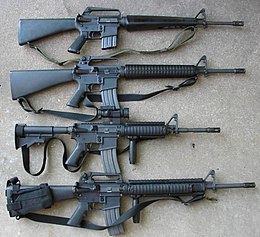
M16 (Rifle)

The M16 rifle, officially designated Rifle, Caliber 5.56 mm, M16, is the United States military version of the AR-15 rifle. The rifle was adapted for semi-automatic, three-round burst, and full-automatic fire.Colt purchased the rights to the AR-15 from ArmaLite, and currently uses that designation only for semi-automatic versions of the rifle. The M16 fires the 5.56×45mm NATO cartridge. The rifle entered United States Army service and was deployed for jungle warfare operations in South Vietnam in 1963,becoming the U.S. military's standard service rifle of the Vietnam War by 1969,replacing the M14 rifle in that role. The U.S. Army retained the M14 in CONUS, Europe, and South Korea until 1970. Since the Vietnam War, the M16 rifle family has been the primary service rifle of the U.S. armed forces.
The M16 has also been widely adopted by other militaries around the world. Total worldwide production of M16s has been approximately 8 million, making it the most-produced firearm of its caliber.In 2010, the M16 began to be phased out in the U.S. Army and is being supplemented by the M4 carbine, which is itself a shortened derivative of the M16A2.
TypeAssault rifle
Place of originUnited States of America
Service history
In service1963–present

WarsVietnam War
Laotian Civil War
Cambodian Civil War
Cambodian–Vietnamese War
Invasion of Grenada
Invasion of Panama
Gulf War
Somali Civil War
Operation Deny Flight
Operation Joint Endeavor
War in Afghanistan
Iraq War
Production history
DesignerEugene Stoner and L. James Sullivan[1]
Designed1956[2]
Manufacturer
  • United States Colt Defense
  • South Korea Daewoo Precision Industries
  • Belgium FN Herstal
  • United States H & R Firearms
  • United States General Motors HydramaticDivision
  • Philippines Elisco
  • United States U.S. Ordnance
Produced1959–present[2]
Number built~10 million[3]

Specifications (M16)
Weight7.18 lb (3.26 kg) (unloaded)
8.79 lb (4.0 kg) (loaded)
Length39.5 in (1,000 mm)
Barrel length20 in (508 mm)

Cartridge5.56×45mm NATO
ActionGas-operated, rotating bolt (direct impingement)
Rate of fire12–15 rounds/min sustained
45–60 rounds/min semi-automatic
700–950 rounds/min cyclic
Muzzle velocity3,110 ft/s (948 m/s)
Effective range550 meters (point target)
800 meters (area target)
Feed system20-round box magazine:
(0.211 lb [96 grams] empty / 0.738 lb [335 g] full)
30-round box magazine:
(0.257 lb [117 g] empty / 1.06 lb [483 g] full)
Beta C-Mag 100-round double-lobed drum:
(2.2 lb [1 kg] empty / 4.81 lb [2.19 kg] full)

Introduction


The M16 is a lightweight, 5.56 mm, air-cooled, gas-operated, magazine-fed assault rifle, with a rotating bolt, actuated by direct impingement gas operation. The rifle is made of steel, 7075 aluminum alloy, composite plastics and polymer materials.
In the early 1960s, the U.S. Air Force's rifle, the M16, and the Army's XM16E1, were the first versions of the M16 rifle fielded. Soon, the U.S. Army standardized an upgrade of the XM16E1 as the M16A1 rifle, an M16 with a forward assist feature and other improvements requested by the Army. All of the early versions were chambered to fire the M193/M196 cartridge in the semi-automatic and the automatic firing modes. This occurred in the early 1960s, with the Army issuing it in late 1964.Commercial AR-15s were first issued to Special Forces troops in spring of 1964.


The M16A2 rifle entered service in the 1980s, being ordered in large scale by 1987, chambered to fire the standard NATO cartridge, the Belgian-designed M855/M856 cartridge.The M16A2 is a select-fire rifle (semi-automatic fire, three-round-burst fire) incorporating design elements requested by the Marine Corps:an adjustable, windage rear-sight; a stock 5⁄8 inches (15.9 mm) longer; heavier barrel; case deflector for left-hand shooters; and cylindrical handguards. The fire mode selector is on the receiver's left side.
The M16A3 rifle is an M16A2 rifle with an M16A1's fire control group (semi-automatic fire, automatic fire) that is used only by the U.S. Navy and U.S. Coast Guard. The Coast Guard replaced their upper receivers with A2 receivers in the mid 90's, but retained the full auto capability by mounting the new A2 upper receiver on the old full auto lower receiver.
The M16A4 rifle was standard issue for the United States Marine Corps in Operation Iraqi Freedom after 2004; it replaced the M16A2 in front line units. In the U.S. Army, the M16A2 rifle is being supplemented with two rifle models, the M16A4 and the M4 carbine, as the standard issue assault rifle. The M16A4 has a flat-top receiver developed for the M4 carbine, a handguard with four Picatinny rails for mounting a sight, laser, night vision device, forward handgrip, removable handle, or a flashlight.
The M16 rifle is principally manufactured by Colt and Fabrique Nationale de Herstal (under a U.S. military contract since 1988 by FNH-USA; currently in production since 1991, primarily M16A2, A3, and A4), with variants made elsewhere in the world. Versions for the U.S. military have also been made by H & R FirearmsGeneral Motors Hydramatic Division and most recently by Sabre Defence.Semi-automatic versions of the AR-15 are popular recreational shooting rifles, with versions manufactured by other small and large manufacturers in the U.S.


5.56 mm cartridge

The 5.56x45mm cartridge originally developed by Armalite had many advantages over the 7.62x51mm NATO round used in the M14 rifle. Most of these reasons were due to the dense and humid jungle in which US soldiers were fighting during the Vietnam War. The 5.56 mm cartridge was developed as a more medium range alternative to the larger caliber round used in M14 and M1A rifles; each soldier can carry more ammunition and engage enemy targets more effectively at shorter distances. It was also found useful in automatic and burst fire, developing the M16 into variants such as the M16A3 and current M16A4.[citation needed]
[edit]History

Thursday, May 2, 2013

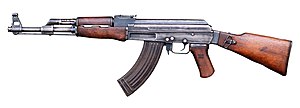
AK 47


TypeAssault rifle
Place of originSoviet Union
Service history
In service1949–present
Used bySee Users
Production history
DesignerMikhail Kalashnikov
Designed1947–1948[1]
ManufacturerIzhmash
Produced1949–1959[2]
Number built≈ 75 million AK-47s, 100 million Kalashnikov-family weapons[3][4]
VariantsSee Variants
Specifications
WeightWithout magazine:
3.47 kg (7.7 lb) AK[5]
2.93 kg (6.5 lb) AKM[6][N 2]
Magazine, empty:
0.43 kg (0.95 lb) (early issue)[5]
0.33 kg (0.73 lb) (steel)[6]
0.25 kg (0.55 lb) (plastic)[7]
0.17 kg (0.37 lb) (light alloy)[6]
Ammo weight:
16.3 g × 30 = 0.49 kg (1.1 lb)[8]
Length880 mm (35 in) fixed wooden stock[citation needed]
875 mm (34.4 in) folding stock extended[citation needed]
645 mm (25.4 in) stock folded[5]
Barrel length415 mm (16.3 in) total[5]
369 mm (14.5 in) rifled[5]

Cartridge7.62×39mm M43/M67
ActionGas-operatedrotating bolt
Rate of fireCyclic 600 rounds/min,[5] practical
40 rounds/min semi-automatic[5]
100 rounds/min fully automatic[5]
Muzzle velocity715 m/s (2,350 ft/s)[5]
Effective range400 metres (440 yd) semi-auto[9]
300 metres (330 yd) full auto[9]
Feed systemStandard magazine capacity is 30 rounds;[5] there are also 10-, 20- and 40-round box and 75- and 100-rounddrum magazines
SightsAdjustable iron sights with a 378 mm (14.9 in) sight radius:[5]
100–800 m adjustments (AK)[5]
100–1000 m adjustments (AKM)[7

Design
The first assault rifle to see service was created in 1915 by Vladimir Fyodorov,following the experience gathered in the Russo-Japanese War. Several countries had already developed and adopted low-power rifle cartridges since 1890s (such as 6.5×52mm Mannlicher-Carcano) as their standard infantry ammunition. The Russo-Japanese war, however, had demonstrated the regular rifles' lack of suppressive firepower,in addition to the excessive range of their ammunition.The latter was also confirmed in World War I. The Fyodorov's assault rifle went out of production after the Soviet armed forces decided to standardize its infantry weaponry around only the most popular types of cartridges following the Russian Civil War. The Soviet Union had returned to the development of an assault rifle in 1942 when the need for an intermediate-powered rifle became clearly evident. By that time submachine guns were already in widespread use but they could not replace service rifles because of limited power of pistol cartridges. Like the Germans, the Soviets designed an intermediate cartridge that could be made on existing production lines (despite Vladimir Fyodorov's insistence on a special small-calibre cartridge).The work on the weapons for the new ammunition commenced in 1943, with the AK-47 of Mikhail Kalashnikov, the SKS-45 of Sergei Simonov and the RPD of Vasily Degtyaryov emerging as the victors.
Mikhail Kalashnikov began his career as a weapon designer while in a hospital after he was shot in the shoulder during the Battle of Bryansk. After tinkering with a submachine gun design, he entered a competition for a new weapon that would chamber the 7.62×41mm cartridge developed by Yelizarov and Syomin in 1943 (the 7.62×41mm cartridge predated the current 7.62×39mm M1943). A particular requirement of the competition was the reliability of the firearm in the muddy, wet, and frozen conditions of the Soviet front line. Kalashnikov designed a carbine, strongly influenced by the American M1 Garand, that lost out to the Simonov design (scaled down PTRS-41), that later became the SKS semi-automatic carbine. At the same time, the Soviet Army was interested in developing a true assault rifle employing a shortened M1943 round. The first such weapon was presented by Sudayev in 1944, but trials found it to be too heavy.A new design competition was held two years later where Kalashnikov and his design team submitted an entry. It was a gas-operated rifle which had a breech-block mechanism similar to his 1944 carbine, and a curved 30-round magazine.
Kalashnikov's rifles (codenamed AK-1 and −2) proved to be reliable and the weapon was accepted to second round of competition along with designs by A. A. Dementyev and A. A. Bulkin. In late 1946, as the rifles were being tested, one of Kalashnikov's assistants, Aleksandr Zaitsev, suggested a major redesign of AK-1, particularly to improve reliability. At first, Kalashnikov was reluctant, given that their rifle had already fared better than its competitors. Eventually, however, Zaitsev managed to persuade Kalashnikov. The new rifle proved to be simple and reliable under a wide range of conditions with convenient handling characteristics. Production of the first army trial series began in the early 1948,and in 1949 it was adopted by the Soviet Army as "7.62 mm Kalashnikov assault rifle (AK)".
The AK-47 is best described as a hybrid of previous rifle technology innovations:the trigger mechanism, double locking lugs and unlocking raceway[citation needed] of the M1 Garand/M1 carbine, the safety mechanism of the John Browning designed Remington Model 8 rifle,[citation needed] and the gas system of the Sturmgewehr 44.Kalashnikov's team had access to all of these weapons and had no need to "reinvent the wheel", though he denied that his design was based on the German Sturmgewehr 44 assault rifle. Kalashnikov himself observed: "A lot of Russian Army soldiers ask me how one can become a constructor, and how new weaponry is designed. These are very difficult questions. Each designer seems to have his own paths, his own successes and failures. But one thing is clear: before attempting to create something new, it is vital to have a good appreciation of everything that already exists in this field. I myself have had many experiences confirming this to be so."There are claims about Kalashnikov copying other designs, like Bulkin's TKB-415 or Simonov's AVS-31.


Receiver development
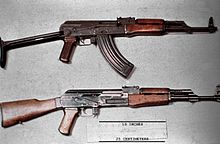
AKMS with a Type 4B receiver (top), and an AK-47 with a Type 2A
There were many difficulties during the initial phase of production. The first production models had stamped sheet metal receivers. Difficulties were encountered in welding the guide and ejector rails, causing high rejection rates. Instead of halting production, a heavy machined receiver was substituted for the sheet metal receiver. This was a more costly process, but the use of machined receivers accelerated production as tooling and labor for the earlier Mosin–Nagant rifle's machined receiver were easily adapted. Partly because of these problems, the Soviets were not able to distribute large numbers of the new rifle to soldiers until 1956. During this time, production of the interim SKS rifle continued.[28]
Once manufacturing difficulties had been overcome, a redesigned version designated the AKM (M for "modernized" or "upgraded" (in Russian: Автомат Калашникова Модернизированный [Avtomat Kalashnikova Modernizirovanniy]) was introduced in 1959.This new model used a stamped sheet metal receiver and featured a slanted muzzle brake on the end of the barrel to compensate for muzzle rise under recoil. In addition, a hammer retarder was added to prevent the weapon from firing out of battery (without the bolt being fully closed), during rapid or automatic fire.This is also sometimes referred to as a "cyclic rate reducer", or simply "rate reducer", as it also has the effect of reducing the number of rounds fired per minute during automatic fire. It was also roughly one-third lighter than the previous model.Both licensed and unlicensed production of the Kalashnikov weapons abroad were almost exclusively of the AKM variant, partially due to the much easier production of the stamped receiver. This model is the most commonly encountered, having been produced in much greater quantities. All rifles based on the Kalashnikov design are frequently referred to as AK-47s in the West, although this is only correct when applied to rifles based on the original three receiver types.In most former Eastern Bloc countries, the weapon is known simply as the "Kalashnikov" or "AK". The photo above at right illustrates the differences between the Type 2 milled receiver and the Type 4 stamped, including the use of rivets rather than welds on the stamped receiver, as well as the placement of a small dimple above the magazine well for stabilization of the magazine.


All current model AK-47 rifles can mount under-barrel 40 mm grenade launchers such as the GP-25, GP-30 & GP-34, which can fire up to 20 rounds per minute and have an effective range of up to 400 metres.The main grenade is the VOG-25 fragmentation grenade which has a 6 metres lethality radius. The VOG-25P ("jumping") variant explodes 0.5–1 metre (1.6–3.3 ft) above the ground.
The Zastava M70s (AKM-type rifle).that are manufactured in Serbia,also have a grenade-launching sight and gas cut-off on the gas block, and are capable of launching rifle grenades. To launch them a 22 mm diameter grenade launching adapter is screwed on in place of the slant brake or other muzzle device.[51] Other AK-47 variants tuned for launching rifle grenades are the Polish Kbkg wz. 1960/72 and the Hungarian AMP-69.
The AK-47 can also mount a (rarely used) cup-type grenade launcher that fires standard RGD-5 Soviet hand-grenades.The soup-can shaped launcher is screwed onto to AK-47's muzzle.To fire first, insert a standard RGD-5 hand-grenade into the launcher and then remove the safety pin. Second, insert a special blank cartridge into the rifles chamber. Third, place the butt-stock of the rifle on the ground and fire from this position. The maximum effective range is approximately 150 metres.The RGD-5 hand-grenade has a lethality radius of 25 metres


CountryVariant(s)
Albania
Automatiku Shqiptar model 56 (ASH-78 Tip-1) Albanian Automatic Assault Rifle Model 56 Type-1 [Made in Poliçan Arsenal] (Straight forward copy of Type 56, which in turn is a clone of the Soviet AKM rifle)

Automatiku Shqiptar Tipi 1982 (ASH-82) Albanian Automatic Assault Rifle Type 1982 [Made in Poliçan Arsenal] (Straight forward copy of AKMS)

Automatiku Shqiptar model 56 (ASH-78 Tip-2) Albanian Light Machine Gun [Made in Poliçan Arsenal] (Straight forward copy of RPK)

Automatiku Shqiptar model 56 (ASH-78 Tip-3) Albanian Automatic Hybrid Rifle Model 56 Type-3 [Made in Poliçan Arsenal] (Hybrid rifle for multi-purpose roles mainly Marksman rifle with secondary assault rifle and grenade launcher capability)

Other unknown variants.
Several other unnamed & unidentified versions of the AKMS have been produce mainly with short barrels similar to the Soviet AKS-74U mainly for special forces, Tank & Armoured crew also for Helicopter pilots and police.
There have also been modifications and fresh production of heavily modified ASh-82 (AKMS) with SOPMOD accessories, mainly for Albania's special forces RENEA & exports.
ArmeniaK-3 (bullpup, 5.45×39mm)
AzerbaijanKhazri (AK-74M)[58]
BangladeshChinese Type 56
Bulgaria
AKK/AKKS (Type 3 AK-47/w. side-folding buttstock)

AKKMS (AKMS), AKKN-47 (fittings for NPSU night sights)

AK-47M1 (Type 3 with black polymer furniture)

AK-47MA1/AR-M1 (same as -M1, but in 5.56 mm NATO)

AKS-47M1 (AKMS in 5.56×45mm NATO)

AKS-47S (AK-47M1, short version, with East German folding stock, laser aiming device)

AKS-47UF (short version of -M1, Russian folding stock), AR-SF (same as −47UF, but 5.56 mm NATO)

AKS-93SM6 (similar to −47M1, cannot use grenade launcher)

RKKS (RPK), AKT-47 (.22 rimfire training rifle)
CambodiaChinese Type 56, Soviet AK-47, and AKM
People's Republic of ChinaType 56
ColombiaGalil ACE
CroatiaAPS-95
CubaAKM
East Germany[60]
MPi-K/MPi-KS (AK-47/AKS)

MPi-KM (AKM; wooden and plastic stock), MPi-KMS-72 (side-folding stock), MPi-KMS-K (carbine)

MPi-AK-74N (AK-74), MPi-AKS-74N (side-folding stock), MPi-AKS-74NK (carbine)

KK-MPi Mod.69 (.22 LR select-fire trainer)
EgyptAK-47, Misr assault rifle (AKM), Maadi
EthiopiaAK-47, AK-103 (manufactured locally at the State-run Gafat Armament Engineering Complex as the Et-97/1)[61]
Finland
Rk 62Valmet M76 (other names Rk 62 76, M62/76), Valmet M78 (light machine gun), Rk 95 Tp
Hungary[52]
AK-55 (domestic manufacture of the 2nd Model AK-47)

AKM-63 (also known as AMD-63 in the US; modernized AK-55), AMD-65M (modernized AKM-63, shorter barrel and side-folding stock), AMP-69 (rifle grenade launcher)

AK-63F/D (other name AMM/AMMSz), AK-63MF (modernized)

NGM-81 (5.56×45mm NATO; fixed and under-folding stock)
India
INSAS (fixed and side-folding stock), KALANTAK (carbine), INSAS light machine gun (fixed and side-folding stock)

Trichy Assault Rifle 7.62 mm, manufactured by Ordnance Factory Tiruchirappalli of Ordnance Factories Board[62]
IranKLS/KLF (AK-47/AKS), KLT (AKMS)
IraqTabuk Sniper Rifle, Tabuk Assault Rifle (with fixed or underfolding stock, outright clones of Yugoslavian M70 rifles series), Tabuk Short Assault Rifle
Israel
IMI Galil: AR (assault/battle rifle), ARM (assault rifle/light machine gun), SAR (carbine), MAR (compact carbine), Sniper (sniper rifle), SR-99 (sniper rifle)

ItalyBernardelli VB-STD/VB-SR (Galil AR/SAR)[63]
NigeriaProduced by the Defence Industries Corporation of Nigeria as OBJ-006[64][65]
North KoreaType 58A/B (Type 3 AK-47/w. stamped steel folding stock), Type 68A/B (AKM/AKMS), Type 88 (AKS-74)[66][67]
PakistanReverse engineered by hand and machine in Pakistan's highland areas (see Khyber Pass Copy) near the border of Afghanistan; more recently the Pakistan Ordnance Factories started the manufacture of an AK-47/AKM clone called PK-10[68]
Poland
pmK (kbk AK) / pmKS (kbk AKS) (name has changed from pmK – "pistolet maszynowy Kałasznikowa", Kalashnikov SMG to the kbk AK – "karabinek AK", Kalashnikov Carbine in mid-1960s) (AK-47/AKS)

kbkg wz. 1960 (rifle grenade launcher), kbkg wz. 1960/72 (modernized)

kbk AKM / kbk AKMS (AKM/AKMS)


Romania
PM md. 63/65 (AKM/AKMS), PM md. 80PM md. 90, collectively exported under the umbrella name AIM or AIMS

PA md. 86 (AK-74), exported as the AIMS-74

PM md. 90 short barrel, PA md. 86 short barrel, exported as the AIMR

PSL (designated marksman rifle; other names PSL-54C, Romak III, FPK and SSG-97)
South AfricaR4 assault rifleTruvelo RaptorVektor CR-21 (bullpup)
SudanMAZ (based on the Type 56)
UkraineVepr (bullpup, 5.45×39mm), Malyuk (bullpup)[71]
VietnamChinese Type 56, Soviet AK-47, AK-74AK-108 and AKM
VenezuelaLicense granted, factory under construction[72]
Yugoslavia/SerbiaM60, M64, M70M76M77M92M21